
Value mutual funds have witnessed robust investor interest, garnering Rs 22,757 crore in inflows in 2024, nearly double the amount seen in 2023, fueled by impressive returns generated by the segment. This surge reflects a shift in investor focus towards fundamentally strong yet undervalued stocks.

With an existing consumer base of 400 million across airports, electricity and gas distribution businesses, the Adani group is revving up its retail play. It is planning to use the 2.4 billion consumer interactions a year with group companies to push various products and services. The group has already launched the 'Adani One' super app that will eventually sell products across the spectrum, top executives said.

Shares of auto component major, Samvardhana Motherson International, has gained 11.5 per cent on the bourses after the company approved the qualified institutions placement (QIP) issue and announced the calculation methodology for its compulsorily convertible debentures, or CCDs, into equity shares. Analysts cite strong investor response to the issue that has kept the sentiment positive for the stock. Brokerages, however, have a mixed view on the outlook for the auto parts supplier.

In a memorable year for the equity market, Dalal Street investors added a whopping Rs 81.90 lakh crore to their wealth in 2023 as a raft of positive factors powered a stellar rally in stocks. Experts said India's strong macroeconomic fundamentals, political stability owing to the BJP's success in recent elections in three significant states, optimistic corporate earnings outlook, signals from the US Federal Reserve about three prospective rate cuts next year and heavy retail investors participation played a major role in fuelling the stock market rally in 2023. In the year 2023, the 30-share BSE Sensex jumped 11,399.52 points or 18.73 per cent.


It has been a choppy calendar year 2022 (CY22) for global financial markets amid the spectre of rising inflation that led most central banks, especially the US Federal Reserve (US Fed), to tighten their monetary policy. Most equity indices across the globe have seen a sharp fall from their respective peak levels in this backdrop. FTSE India, for instance, has corrected 16 per cent from its October peak.

At the same time, seven companies from the coveted list witnessed a decline in their market valuation last week, but their cumulative loss of Rs 37,701.1 crore was less than the total gain made by three firms.

Smaller stocks continue to shine at the bourses. The BSE MidCap index is up 18 per cent since the beginning of January this year against a 5 per cent rise in the Sensex during the period. With the current rally, the mid-cap index has doubled in value since the end of March 2020 against a 70 per cent rally in the Sensex during the period. On Tuesday, the mid-cap index closed at 21,232, as compared to 17,941 at the end of December 2020. In the same period, the benchmark index moved from 47,751 to 50,193.

Among the Sensex firms, State Bank of India, Infosys, Titan, Tech Mahindra, IndusInd Bank, NTPC, ICICI Bank, Power Grid, Reliance Industries and Kotak Mahindra Bank were the major laggards. On the other hand, Tata Motors, Nestle, Hindustan Unilever, Tata Steel, Bajaj Finance and UltraTech Cement were among the gainers.

Market reaction to the Union Budget was overall neutral. The income tax "gift" wasn't enough to move the needle. There was some apparent rationalisation of Customs duty structure as well as cuts on import duties of some key components for the telecom and IT industry and duty cuts on vehicle imports. Other proposals related to development of agriculture and rural economy and renewables seem to be generally positive.

Though most analysts expect the global central banks to keep the liquidity tap open, valuations of Indian markets, they say, are beginning to look stretched. Against this backdrop, they remain cautious, with some even expecting a minor correction from here on.

The Securities and Exchange Board of India (Sebi) on Monday relaxed the norms for valuing perpetual bonds. The norms, which had sought to value banks' deemed residual maturity of Basel III additional tier 1 (AT1) bonds as 100-year debt from April 1, were strongly opposed by the finance ministry. In a statement released on Monday, the regulator said the maturity would be 10 years until March 31, 2022, and would be increased to 20 and 30 years over the subsequent six-month period.

HDFC Bank's market capitalisation (market cap) touched Rs 13 trillion in Thursday's (December 28, 2023) intra-day trades as the largest private sector lender is set to report its sharpest monthly rally in the past two years. At 10:33 AM; HDFC Bank's market cap stood at Rs 13.03 trillion, the BSE data shows. The stock was up 1 per cent at Rs 1,717.90 in intra-day trades on December 29, inching towards its record high of Rs 1,757.80 touched on July 3, 2023.

Benchmark Sensex closed above the 85,000 level for the first time while Nifty scaled the 26,000 peak at close on Wednesday as fag-end buying in banking and power shares helped stock markets recoup early losses. After a see-saw trade during the day, the 30-share BSE Sensex rose by 255.83 points or 0.30 per cent to settle at an all-time high of 85,169.87. During the day, it surged 333.38 points or 0.39 per cent to hit a record intra-day peak of 85,247.42.

Nine of the top-10 most valued domestic companies together added a whopping Rs 2,22,591.01 crore in market valuation last week, with heavyweights RIL, TCS and HDFC twins gaining the most. During the last week, the BSE benchmark Sensex rallied 1,690.88 points or 3.21 per cent. The index reached its all-time high of 54,717.24 on August 5. Barring Bajaj Finance, rest nine companies -- Reliance Industries Ltd (RIL), Tata Consultancy Services (TCS), HDFC Bank, Infosys, Hindustan Unilever Ltd (HUL), ICICI Bank, HDFC, State Bank of India and Kotak Mahindra Bank -- logged gains.

With the benchmark Sensex witnessing a dream-run, total market valuation of BSE listed companies has inched closer to Rs 100 lakh crore milestone.

Two years after his dismissive stance on India's AI potential raised eyebrows here, OpenAI CEO Sam Altman on Wednesday gave a ringing endorsement to Artificial Intelligence momentum in the country -- and billed India as an important market not just for the new-age technology itself but for the ChatGPT creator as well. In New Delhi on Wednesday, Altman -- while sharing dais with Union IT minister Ashwini Vaishnaw -- said India is the second biggest market for the company and that Open AI had tripled its users here in the last year.

SBI Mutual Fund recently launched the SBI Quant Fund. Its new fund offer (NFO) opened on December 4, 2024, and will close on December 18, 2024. Currently, 11 fund houses manage quant funds with assets worth Rs 9,013.6 crore.

After lagging behind the broader market over the past three and six months, defence sector stocks have regained ground, reversing their performance from the past month. Concerns about slowing order inflows, execution hurdles, supply chain disruptions, and high valuations had weighed on the sector.

Foreign investors have injected close to Rs 33,700 crore in domestic equities in this month so far primarily due to interest rate cut in the US and resilience of the Indian market. This also marks the second highest inflow in a month in this year so far, the last one being in March, when Foreign Portfolio Investors (FPIs) infused Rs 35,100 crore, data with the depositories showed. Going ahead, the trend of FPIs buying is likely to continue in the coming days, V K Vijayakumar, Chief Investment Strategist, Geojit Financial Services, said.
Equity investors became richer by Rs 2.4 lakh crore as key benchmark indices Sensex and Nifty scaled new peaks in morning trade on Tuesday, amid persistent foreign fund inflows. Analysts said foreign institutional investors have reversed their selling strategy and have been consistent buyers during the last seven days. This momentum is a reflection of institutional confidence in the Indian market, they said.
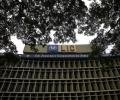
Taking a cue from Zomato's stellar initial public offering (IPO), through which it garnered a valuation of Rs 1 trillion, the government has asked its advisors and valuers to ascertain if the Life Insurance Corporation of India (LIC) should be valued at Rs 10 trillion or more. The government is looking to offload about 10 per cent stake in LIC through the IPO. At that valuation, the government stands to net at least Rs 1 trillion from LIC's proposed IPO, which will boost the Centre's efforts to meet its disinvestment target of Rs 1.75 trillion for the current financial year.

The week's losses wiped out investor wealth worth Rs 18.43 trillion, with the total market capitalisation of BSE-listed firms now at Rs 441 trillion.

'Forget your loss or profit in your portfolio.' 'Look at how much cash you have in hand.' 'If you don't have cash in hand, liquidate at least partially; get into about 20 per cent in cash.'

'Such big falls are quite frequent these days, so do not try to time this market.' 'Use big dips to accumulate quality stocks.'

'If it doesn't, it will continue with measures to infuse liquidity, signalling a new cycle,' predicts Tamal Bandyopadhyay.

'There is a lot of interest from potential clients who have remained away from the markets in past years.' 'They are evaluating whether this is a good time to enter, especially since there are very few alternatives to earn meaningful returns.'

'...you evaluate three key factors before committing your money.'

Public sector banks (PSBs) have proposed the Finance Ministry their plan to raise Rs 54,800 crore through Additional Tier-1 (AT-1) and Tier-2 bonds in the current financial year (FY25), 37 per cent more than the Rs 39,880 crore raised in FY24
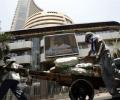
Except RIL and CIL, the remaining eight companies among the top 10 witnessed slump in their m-cap

After heavy selling in the past two months, foreign investors have staged a strong comeback to Indian equities with a net investment of Rs 24,454 crore in the first week of December amid stabilising global conditions and expectations of potential US Federal Reserve rate cuts. This revival follows significant outflows in the preceding months, with foreign portfolio investors (FPIs) pulling out a net Rs 21,612 crore in November and a massive Rs 94,017 crore in October - the worst monthly outflow on record.

Byju's is raising about Rs 2,200 crore ($300 million) as part of a larger round of new investment as the world's most valuable edtech company focuses on expanding its business in global markets and explores to do more acquisitions. According to industry sources, the new funding may value Bengaluru-based Byju's at $18 billion, up from a valuation of $16.5 billion in June this year. In June, Byju's became India's most valuable unicorn with a valuation of $16.5 billion, surpassing fintech company Paytm's $16 billion valuation.

In line with the broader market, shares of ONGC on Tuesday surged nearly one per cent to touch an intra-day high of Rs 1,415 thus, fuelling the market capitalisation of the firm to a whopping Rs 3,00,511 crore (Rs 3,005.11 billion) in the morning trade.

India's top IT companies have shown a hiatus between their performance on the bourses in the pandemic period and earnings growth. The combined market cap of the top five IT companies - Tata Consultancy Services, Infosys, Wipro, HCL Technologies, and Tech Mahindra - is up 87 per cent since the end of March 2020. In comparison, the benchmark BSE Sensex is up 68 per cent during the period. So the industry beat the broader market by a big margin in the last one year.

The 15 Indian entities listed on the New York Stock Exchange and Nasdaq saw their cumulative market value plummet.

'Market feels this Budget will promote all-round growth and that is what is giving it confidence.'
The 55 basis point (bps) spike in the US 10-year bond yield, triggered by a combination of FOMC's hawkish commentary and BOJ's relaxation of the yield control curve (YCC) has made analysts cautious on Asian equities and expect them to trade sideways in the short-to-medium term.

The market valuation of Reliance Industries, the country's most valued firm, is fast nearing the Rs 10 lakh crore mark, surpassing British energy major BP Plc.

Information technology (IT) stocks ended at their lowest in nearly nine months after a fresh bout of selling, triggered by concerns over a recession in the US, the key market for domestic software exporters. A report by Morgan Stanley citing risks to growth also weighed on sentiment.

'The biggest near-term risk to Indian equities is the outflow of investments to China as tactical trades by foreign investors.'
